SEO Is No Longer the Whole Search Journey: Where Do Indians Ask AI Instead?
BrandThink
Growth Field Notes
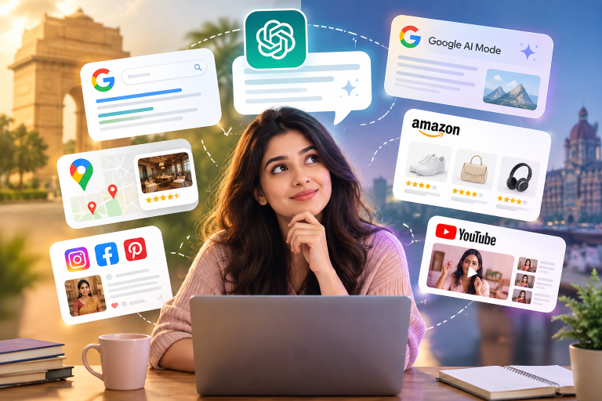
For years, the search journey was pretty easy to understand. You had a question, you opened Google, typed a few words, checked the results and clicked a website. That habit is changing. AI search in India is now becoming part of how people discover information, compare choices and decide what to do next.
The bigger change is not that Indians have stopped using Google. They have not.
Instead, search is spreading across different places.
You might use Google to find a product category, ChatGPT to compare options, Google Maps to check nearby businesses and Amazon or Flipkart when you are ready to buy. For some questions, you might even ask an AI assistant before opening a search engine at all.
YouGov’s 2026 India research describes this shift as a fragmented discovery journey across search engines, AI assistants, maps, marketplaces and other platforms. The research is based on a survey of more than 1,000 Indian adults.
So, what does this mean for SEO?
1. Indians Are No Longer Searching in One Place
Think about a simple question.
“Where should I buy running shoes in Pune?”
You could search Google.
Then you might check Google Maps for nearby stores. You may visit Amazon or another marketplace to compare prices. You could ask ChatGPT which shoes are suitable for beginners. Then you may return to Google to check reviews.
The journey keeps moving.
This is what makes modern AI search behaviour different from traditional search behaviour.
People are choosing platforms based on the type of answer they want.
Here is a simple way to look at it:
- →Google for websites, current information and broad discovery
- →ChatGPT search for explanations, comparisons and follow-up questions
- →Google AI Mode for longer and more complex searches
- →Google Maps for local businesses and directions
- →Amazon and Flipkart for product discovery
- →YouTube for demonstrations and reviews
- →Social platforms for recommendations and opinions
As a result, ranking on Google alone does not tell the whole story anymore.
2. ChatGPT Search Is Becoming Part of the Research Stage
People often ask AI assistants questions they would previously search on Google.
For example:
- →“Which laptop should I buy under ₹70,000?”
- →“Which wedding planner is better for a destination wedding?”
- →“What should I check before buying a used car?”
- →“Compare these three skincare products.”
These are not just keyword searches.
They are conversations.
The user can ask a follow-up question immediately. They can change the budget, add a location or ask for a comparison without starting from scratch.
That changes how brands need to create content.
A page that simply targets “best laptops under ₹70,000” may not answer the deeper questions.
A stronger resource could explain:
- →What specifications actually matter
- →Which users need which type of laptop
- →Common mistakes buyers make
- →How to compare battery life
- →What warranty terms to check
- →Which features are useful and which are unnecessary
That gives AI systems more useful information to understand and reference.
3. Google AI Mode Makes Search More Conversational
Google itself is changing the search experience.
Google says AI Overviews and AI Mode can help users explore complicated questions, comparisons and follow-up searches. These systems can also use multiple related searches to develop a response.
This matters for SEO teams because a user may no longer type five separate searches.
Instead, they might ask one long question.
For example: “Find the best wedding venues near Mumbai for 200 people, compare their approximate pricing and tell me what I should ask before booking.”
That single query contains several smaller searches. The user wants location, options, pricing, comparison, and buying advice.
Google calls this type of process query fan-out, where related searches can be used across different subtopics and sources.
So, content needs to answer connected questions, not just one keyword.
4. Maps and Marketplaces Are Becoming Search Engines Too
This is one part of the change that SEO teams can easily miss.
When someone wants a restaurant, salon, dentist, hotel or local service, they may go directly to Maps.
When someone wants a product, they may start on a marketplace.
That means the search journey depends on intent. For example:
Local intent: “Best dentist near me” — Google Maps may be more useful than a blog.
Product intent: “Best hair straightener under ₹3,000” — A marketplace may become the next destination.
Research intent: “How does ceramic hair straightening work?” — Google or an AI assistant may be the better starting point.
Comparison intent: “Brand A vs Brand B for thin hair” — An AI assistant may provide the first comparison, followed by visits to product pages and reviews.
This is why AI search in India should not be treated as a replacement for SEO. It is part of a wider discovery system.
5. E-E-A-T Matters More When AI Has to Choose Sources
There is a common misunderstanding around E-E-A-T. E-E-A-T does not work as one separate Google “algorithm” that gives a website an E-E-A-T score.
Google describes E-E-A-T as experience, expertise, authoritativeness and trustworthiness. Google also says trust is the most important part of the framework.
For brands trying to appear in AI-generated answers, this becomes especially useful. Ask yourself:
- →Experience: Have you actually used, tested or worked with what you are discussing?
- →Expertise: Does the content show real knowledge of the subject?
- →Authoritativeness: Does your website have a clear reputation in the topic?
- →Trustworthiness: Can readers verify your claims, sources and business information?
For example, a dental clinic can publish general oral health content. But a stronger page can also include the dentist’s credentials, author information, treatment experience and clear sources.
A fashion brand can explain styling trends. It can also show real product images, sizing information, material details and examples from actual customers.
Google encourages clear authorship and useful information about who created the content when that information would reasonably matter to readers. That same clarity can help when AI systems need to understand whether a source is worth referencing.
6. AEO and GEO Need Real Answers, Not Keyword Stuffing
AEO means Answer Engine Optimization. GEO is commonly used for Generative Engine Optimization. The names are relatively new, but the basic idea is simple: create content that clearly answers real questions.
For example, instead of writing “Best wedding planner India” and repeating that phrase throughout the page, answer the questions people actually ask:
- →How much does a wedding planner cost in India?
- →What does a wedding planner handle?
- →How early should you book one?
- →What is included in a destination wedding package?
- →What should you ask before signing a contract?
This structure helps people first. It also gives search and AI systems clear information to understand.
Google's current guidance says the fundamental SEO practices still matter for AI features. Pages need to be crawlable, indexable and useful, while content should provide unique value rather than simply repeat information found elsewhere. So, do not throw away traditional SEO. Build on it.
7. What Fragmented Search Means for SEO Teams
This is probably the biggest change. An SEO team can no longer ask only: “What keywords are ranking?”
A better set of questions is:
- →Where does our audience start its research?
- →Which questions are they asking AI?
- →Which platforms influence their decision?
- →Does our business appear in local results?
- →Are our products visible on marketplaces?
- →Can AI systems understand our brand?
- →Are our authors and experts clearly identified?
- →Are our important facts easy to verify?
- →Does our content answer follow-up questions?
This changes reporting too. Organic traffic still matters. Rankings still matter. Search Console data still matters. At the same time, teams should start watching brand mentions, AI citations, referral sources, local visibility, product visibility and the questions customers ask before converting. That is where AI search behaviour becomes useful as a business signal.
How Brands Can Prepare for the New Search Journey
You do not need to rebuild your entire SEO strategy overnight. Start with these steps:
- →1. Map the full customer journey: List where customers discover, compare and purchase your product or service.
- →2. Build question-led content: Find the questions people ask before making a decision. Answer them directly.
- →3. Strengthen first-hand information: Add original data, examples, expert opinions, product experience, case studies and real observations.
- →4. Improve entity clarity: Make your brand, products, people, locations and services easy to understand.
- →5. Strengthen local and marketplace visibility: If your business depends on location or products, do not focus only on your website.
- →6. Keep technical SEO healthy: AI visibility still depends on strong fundamentals. Google says pages need to meet normal Search technical requirements to be eligible for AI feature links.
- →7. Track AI visibility separately: Search for your brand and important category questions across AI assistants and Google’s AI experiences. Look at what sources appear. Then ask why.
What Should SEO Look Like Next?
SEO is not disappearing. The search journey is expanding.
Google remains important, but users now move between search engines, AI assistants, maps, marketplaces, videos and social platforms depending on what they want to accomplish. That means the future SEO team will need to think beyond rankings.
The real question will be: “Can my brand be discovered wherever my customer is looking for an answer?”
AI search in India is making that question much harder to ignore. And honestly, that is probably a good thing. It pushes brands to create information that is actually useful instead of content written only to capture a keyword.
Frequently Asked Questions
What is AI search in India?
AI search in India refers to the growing use of AI assistants and AI-powered search experiences to discover information, compare options, ask questions and make decisions.
Is ChatGPT replacing Google in India?
Not completely. Current research points to a fragmented search journey where people use search engines alongside AI assistants and other platforms. The tool people choose depends on the task.
What is Google AI Mode?
Google AI Mode is an AI-powered search experience designed for more complex questions, exploration and comparisons. It can provide a detailed response while also linking to supporting websites.
Does SEO still matter for AI search?
Yes. Google says its existing SEO fundamentals remain relevant for AI features. A page still needs to be accessible, indexable and useful to have a chance of appearing as a supporting source.
How can a brand improve AI visibility?
Start with useful, original content. Answer real customer questions, show experience and expertise, maintain accurate business information, strengthen technical SEO and track how your brand appears across AI and search experiences.
Ready to Check Your AI Visibility?
An AI visibility audit can show where your brand appears, where competitors are being mentioned instead, which questions you are missing and what content can strengthen your presence across search and AI platforms.
Related Insights
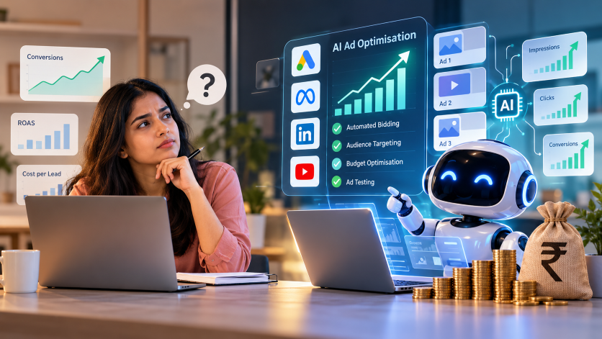
Are AI Ad Platforms Making Marketers Better at Performance - or Just Better at Spending?
Are AI ad platforms making marketers better or just spending faster? Explore AI performance marketing, automated bidding, AI optimisation, and smarter paid media.
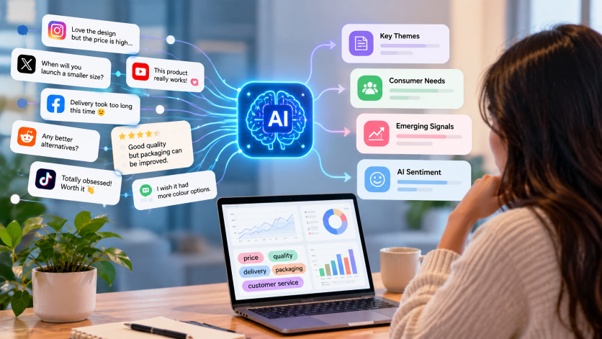
Social Listening Is Becoming AI Consumer Intelligence - Here’s What Changes!
Discover how AI social listening turns millions of conversations into consumer intelligence, themes, needs and early signals for smarter marketing and product decisions.

The Marketing Agent Is Here: What Should Brands Actually Let AI Do?
AI agents for marketing are moving from experiments to everyday work. What should we actually allow an AI agent to do without asking a human every five minutes?
Ready To Make Your Stack Work Together?
Bring us the complexity. We'll help turn disconnected platforms, data and workflows into a MarTech system built around your business.