The Marketing Agent Is Here: What Should Brands Actually Let AI Do?
BrandThink
Growth Field Notes

AI agents for marketing are moving from experiments to everyday work. Forrester reported in September 2026 that 83% of B2C marketing decision-makers surveyed were actively implementing agentic AI in their workflows, while 85% said it was delivering meaningful business value.
That changes the question for marketers.
It is no longer just, “Can AI write this campaign?”
The better question is, “What should we actually allow an AI agent to do without asking a human every five minutes?”
That distinction matters.
A marketing agent can research, analyse data, create content, monitor campaigns and even take certain actions. But that does not mean you should hand over every marketing decision to it.
Some decisions need context.
Some need taste.
And some simply need a human being who understands what the brand should and should not say.
What Is An AI Marketing Agent?
A normal AI tool usually waits for your instruction. You ask it to write an email. It writes the email. You ask it to analyse campaign data. It analyses the data.
An AI agent can work through a series of tasks toward a goal.
For example, imagine you tell an agent: “Find our weakest-performing paid campaigns from the last seven days, compare them with previous results, identify possible reasons, suggest changes and prepare a report.”
The agent may:
- →Collect campaign data
- →Compare performance
- →Find unusual changes
- →Group campaigns by issue
- →Suggest actions
- →Prepare a report
- →Send the report to the marketing team
That is where agentic marketing becomes different from simply using ChatGPT for copywriting. The agent is not only generating an answer. It is helping move work forward.
1. Let AI Agents Handle Marketing Research
Research is one of the safer areas for marketing AI agents. There is a lot of repetitive work involved in understanding what is happening around your brand.
An agent can help monitor:
- →Search trends
- →Competitor content
- →Customer questions
- →Product reviews
- →Campaign performance
- →Website behaviour
- →Social conversations
- →Search visibility
- →Content gaps
For example, an agent could review your Google Search Console data every week and identify pages that gained impressions but lost clicks. It could then group those pages by topic and suggest which ones deserve attention.
You still make the final call. The agent simply gets you to the useful information faster.
2. Let AI Assist With Content, Not Own Your Brand Voice
Content is another obvious use for AI agents. But this is where brands can get careless.
A marketing agent can research a topic, create an outline, suggest FAQs, identify related questions and prepare a first draft. That is useful. But should it publish everything automatically? Probably not.
Your brand has opinions, customer expectations and boundaries that may not exist inside a prompt. A human should still review:
- →Brand claims
- →Product promises
- →Customer stories
- →Statistics
- →Sensitive topics
- →Expert statements
- →Final messaging
- →Tone of important campaigns
For SEO and AEO, this becomes even more important. AI-generated content that simply repeats information already available online gives readers very little reason to trust your brand.
Google's guidance focuses on helpful, original content and asks creators to think about who created the content, how it was produced and why it exists. So use AI to speed up research and production. Do not use it as an excuse to remove human experience from your content.
3. Let Autonomous Workflows Handle Repetitive Campaign Tasks
This is probably where marketing teams can save the most time. Think about the small tasks that happen every week. Someone checks campaign performance. Someone downloads a report. Someone compares this week's numbers with last week's. Someone notices a drop. Someone creates a Slack update. Someone prepares a meeting document.
An autonomous workflow can connect several of these steps. For example:
- →1. Check campaign performance every morning.
- →2. Compare results against predefined thresholds.
- →3. Flag unusual changes.
- →4. Identify the affected campaigns.
- →5. Create a short explanation.
- →6. Send the report to the marketing manager.
That is a reasonable job for an AI agent. The human does not need to spend 30 minutes finding the problem. The human spends five minutes deciding what to do about it. That difference can add up quickly.
4. Use AI Agents for Marketing Analytics
Marketing teams have no shortage of data. The problem is usually knowing what deserves attention. Forrester reported in 2026 that 49% of B2C marketing decision-makers said analytics findings still did not translate into action.
That is a useful reason to look at agents. An agent can move from: “What happened?” to: “What changed?” Then: “Why might it have changed?” And finally: “What should the team investigate next?”
For example, suppose organic traffic falls by 15%. An agent could check search rankings, search impressions, click-through rates, landing pages, recent content changes, technical issues, search demand, and conversion data. It could then prepare possible explanations.
But there is a catch: possible explanation does not mean proven explanation. A marketer still needs to verify the cause before changing strategy.
5. Keep Strategic Decisions Human-Owned
This is the part brands should take seriously. AI can recommend. It can compare. It can predict. It can spot patterns. But should an agent decide what your brand stands for? No.
Some decisions should remain human-owned. These include:
- →Brand positioning
- →Major pricing decisions
- →Reputation-sensitive campaigns
- →Crisis communication
- →Audience exclusions
- →Brand partnerships
- →Major budget shifts
- →Sensitive customer communication
- →Claims that could affect trust
- →Long-term brand direction
Why? Because these decisions involve context that is difficult to reduce to historical data.
Imagine an agent recommends a campaign because similar messages performed well last year. A human marketer might know something the data does not. Perhaps customers are currently frustrated with the company. Perhaps a competitor just faced a major controversy. Perhaps the campaign would sound insensitive during a particular event. The numbers may not show that immediately. People can.
6. Build Marketing AI Agents Around Clear Boundaries
The biggest mistake is giving an agent a vague instruction such as: “Run our marketing.” That sounds impressive. It is also a bad operating model. Instead, define exactly what the agent can do.
A simple framework is:
Green tasks
The agent can act independently. Examples:
- →Reporting
- →Data collection
- →Keyword clustering
- →Internal summaries
- →Campaign alerts
- →Competitor monitoring
Yellow tasks
The agent can prepare the work, but a human approves it. Examples:
- →Ad copy
- →Email campaigns
- →Blog drafts
- →Budget recommendations
- →Landing page changes
- →Customer segmentation
Red tasks
The agent should not act independently. Examples:
- →Crisis communication
- →Major pricing changes
- →Legal claims
- →Sensitive customer responses
- →Brand reputation decisions
- →Major strategic changes
This makes agentic marketing much easier to manage. You are not asking, “Can AI do marketing?” You are asking, “Which marketing tasks can AI safely own?” That is a much better question.
7. Make E-E-A-T Part of Your AI Content Process
One correction is important here. E-E-A-T is not an “E-E-A-T algorithm” that you can simply add to a page.
Google describes E-E-A-T through four areas: Experience, Expertise, Authoritativeness, and Trustworthiness. Google also says E-E-A-T itself is not a specific ranking factor. Instead, these concepts help explain qualities associated with helpful content.
So how should brands use it with AI?
- →Experience: Add real examples. Show what your team has actually tested, observed or learned.
- →Expertise: Use people who understand the subject. For technical, financial, medical or specialised topics, expert review matters even more.
- →Authoritativeness: Make the source of your information clear. Use accurate author profiles, credible references and relevant credentials where appropriate.
- →Trust: Check every important claim. Do not let an AI agent invent statistics, customer results or product claims.
Google also recommends clear authorship information and warns against creating misleading author identities. This gives your AI-assisted content a much stronger foundation.
Where AI Agents Fit Across the Marketing Funnel
A useful way to think about marketing AI agents is by the type of work they handle.
| Marketing area | Good AI agent role | Human role |
|---|---|---|
| Research | Collect and organise information | Decide what matters |
| Content | Research, outline and draft | Add experience and review |
| SEO | Find patterns and opportunities | Set priorities |
| Campaigns | Monitor and flag changes | Approve major actions |
| Analytics | Find anomalies and trends | Interpret business context |
| Operations | Run repetitive workflows | Set rules and controls |
| Customer communication | Prepare responses | Handle sensitive situations |
| Strategy | Generate scenarios | Make the decision |
This division keeps the technology useful without letting it become the decision-maker by default.
What Should Brands Do Next?
Do not start by buying five AI tools. Start with your existing marketing workflow. Write down the tasks your team repeats every week. Then ask:
- →Does this task require human judgment?
- →Does it involve sensitive information?
- →Can the result be checked easily?
- →Does it follow clear rules?
- →Would automation save meaningful time?
- →What happens if the agent gets it wrong?
Start with low-risk tasks. Measure the results. Then expand. That approach is slower than saying “AI will run everything,” but it is much easier to control.
The Future of Marketing Is Probably Human Plus Agent
The rise of autonomous workflows does not automatically mean fewer marketers. It may mean different work for marketers.
Instead of spending hours pulling reports, marketers can spend more time interpreting them. Instead of manually collecting competitor data, they can spend more time deciding what the changes mean. Instead of starting every article from a blank page, they can focus on original insights and real customer experience. That is where the real opportunity sits.
AI agents can handle the movement of information and repetitive work. People still need to decide where the brand is going. And honestly, that separation may be healthier for marketing teams. Let AI do the work that follows clear rules. Let people own the decisions that shape trust.
Want to Know Where AI Can Fit Into Your Marketing Workflow?
Start with an AI workflow audit. Map your campaign, content, SEO, analytics and marketing operations. Then separate tasks into those AI can handle, those that need human approval and those that should remain completely human-owned. The goal is not to put AI everywhere. The goal is to put AI where it actually helps.
Related Insights
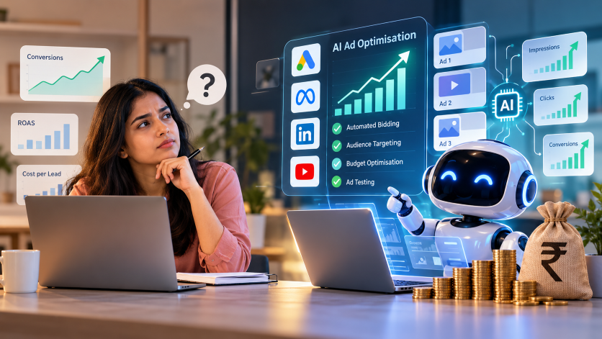
Are AI Ad Platforms Making Marketers Better at Performance - or Just Better at Spending?
Are AI ad platforms making marketers better or just spending faster? Explore AI performance marketing, automated bidding, AI optimisation, and smarter paid media.
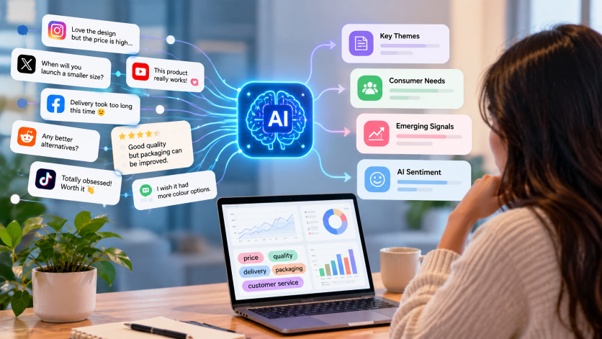
Social Listening Is Becoming AI Consumer Intelligence - Here’s What Changes!
Discover how AI social listening turns millions of conversations into consumer intelligence, themes, needs and early signals for smarter marketing and product decisions.
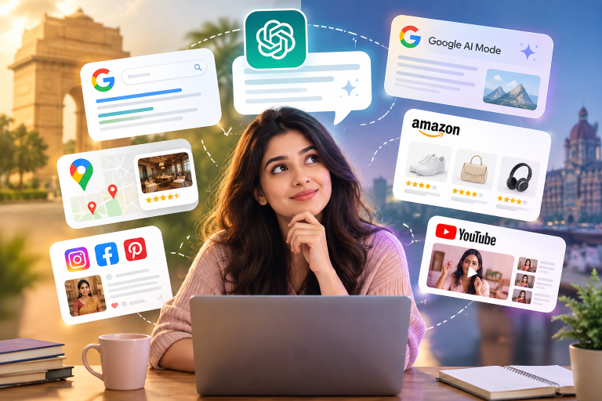
SEO Is No Longer the Whole Search Journey: Where Do Indians Ask AI Instead?
AI search in India is now becoming part of how people discover information, compare choices and decide what to do next across search engines, AI assistants, maps and marketplaces.
Ready To Make Your Stack Work Together?
Bring us the complexity. We'll help turn disconnected platforms, data and workflows into a MarTech system built around your business.