Your ROAS Looks Great. So Why Isn’t the Business Growing?
BrandThink
Growth Field Notes
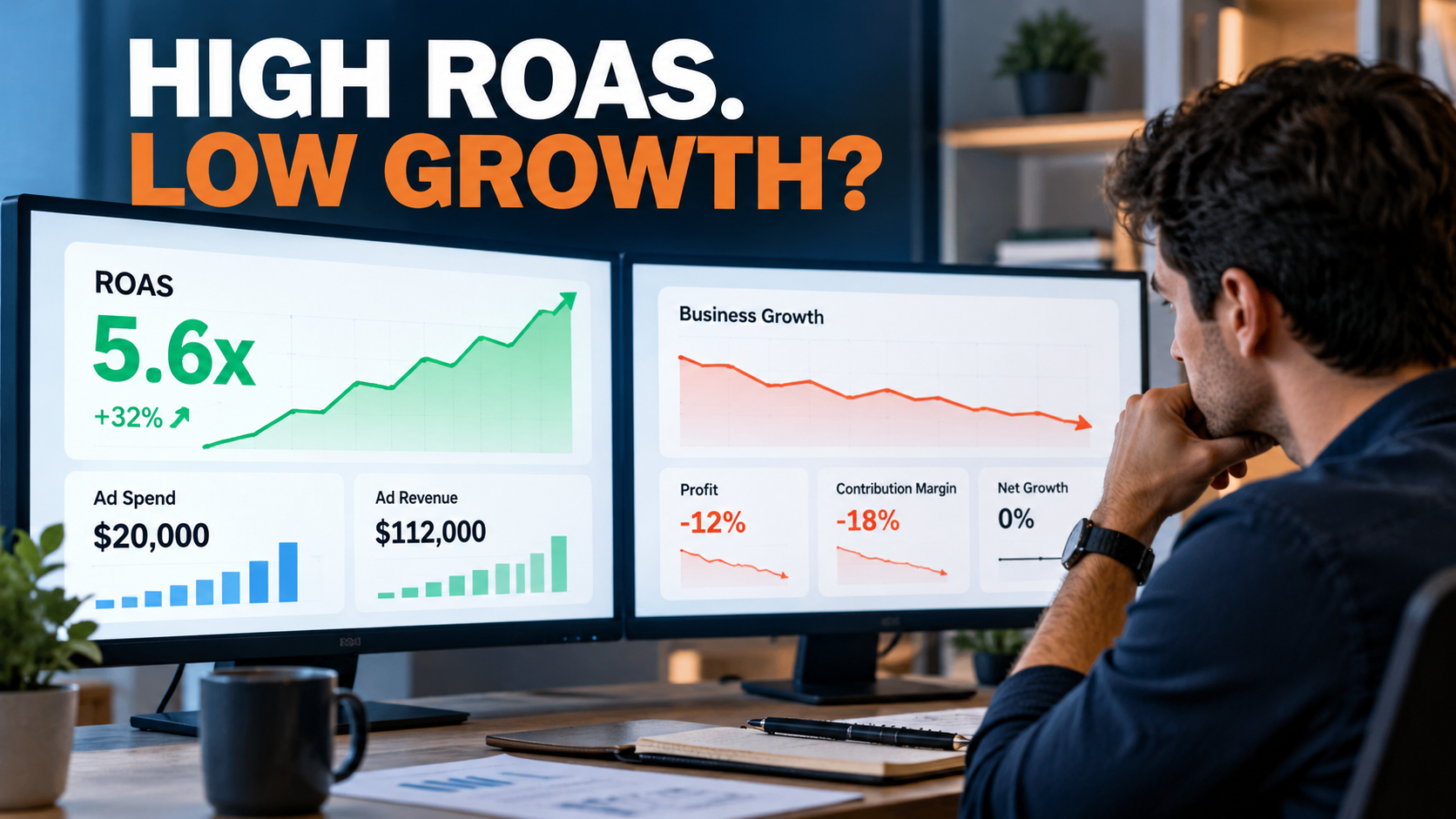
Your ROAS looks great. Your ad campaigns are bringing in sales, your dashboards show positive numbers, and your marketing team seems to be doing everything right. Yet, when you look at your actual business performance, something feels off. Revenue is not growing as expected, profit margins are getting tighter, and customer acquisition costs keep rising. This is where the gap between ROAS profitability and real business growth becomes clear. A high return on ad spend does not always mean your business is making more money. Sometimes, it simply means your advertising platform is reporting a good result without showing the full picture.
So, what is really happening? And more importantly, what should you measure beyond platform ROAS to understand whether your marketing is helping your business grow?
Let's break it down.
What Is ROAS and Why Can It Be Misleading?
ROAS, or Return on Ad Spend, measures the revenue generated for every rupee spent on advertising.
The formula is simple.
ROAS = Revenue Attributed to Ads ÷ Advertising Spend
For example, if you spend ₹1,00,000 on Google Ads and generate ₹5,00,000 in attributed revenue, your ROAS is 5x.
That sounds like a good result, right?
But there is a problem. ROAS only measures the revenue attributed to advertising. It does not automatically account for product costs, shipping, discounts, returns, payment fees, or other business expenses.
A campaign can report a 5x ROAS and still lose money.
This is why businesses need to look beyond advertising revenue and understand what they actually earn from each sale.
7 Reasons Your ROAS Looks Great but Your Business Isn’t Growing
1. Your Revenue Is Growing, but Your Profit Margins Are Shrinking
One of the biggest mistakes brands make is treating revenue as profit.
Let's say you sell a product for ₹2,000.
Your advertising cost per sale is ₹400, which gives you a 5x ROAS.
At first, this looks profitable. But now consider your other costs.
- →Product cost: ₹900
- →Shipping and packaging: ₹150
- →Payment processing: ₹50
- →Advertising cost: ₹400
Your total cost is ₹1,500.
That leaves you with ₹500 before accounting for other overheads, taxes, and operational expenses.
Now imagine you offer a 20% discount to increase sales. Your revenue drops to ₹1,600, while most of your costs remain the same.
Suddenly, your profit margin looks very different.
This is why ROAS profitability needs to be evaluated alongside contribution margin.
Contribution margin tells you how much money remains after variable costs. It helps you understand whether each additional sale is actually contributing to the business.
2. Your Ads Are Taking Credit for Sales That Would Have Happened Anyway
This is where incrementality becomes important.
Imagine a customer has already decided to buy from your brand. They visit your website, search for your brand name on Google, click your paid ad, and complete the purchase.
Your advertising platform may attribute that sale to the campaign.
But would the customer have purchased without the ad?
Quite possibly.
This is especially common with branded search campaigns, remarketing ads, and campaigns targeting existing customers.
The problem is that attributed revenue is not always incremental revenue.
Incrementality measures the additional sales or conversions generated because of your marketing activity.
For example:
- →Your campaign reports 1,000 conversions.
- →A control group suggests that 300 of those conversions would have happened anyway.
- →Your estimated incremental conversions are 700.
The campaign may look less impressive when measured this way. But the result is more useful because it shows the actual impact of advertising.
If you want to understand whether your marketing is creating new demand or simply capturing existing demand, incrementality testing is worth considering.
3. Your Customer Acquisition Cost Is Increasing
A campaign can maintain a strong ROAS while your customer acquisition cost (CAC) gradually increases.
How does that happen?
Your business might be generating more revenue from existing customers, larger orders, or repeat purchases. At the same time, acquiring new customers may be getting more expensive.
For example, your average order value could increase from ₹2,000 to ₹3,000.
Even if your cost per acquisition rises from ₹400 to ₹600, your ROAS remains at 5x.
But what if your business needs new customers to grow?
A rising CAC can make future growth harder, especially when customers take months to generate enough repeat revenue to cover their acquisition costs.
You should track:
- →New customer CAC
- →Returning customer CAC
- →Customer lifetime value (LTV)
- →Payback period
- →First-order contribution margin
These metrics help you understand whether your acquisition strategy can support long-term growth.
4. Your Marketing Is Relying Too Much on Existing Customers
Repeat customers are valuable. They already know your brand and may be more likely to purchase again.
But there is a difference between retaining customers and acquiring new ones.
Suppose your remarketing campaigns generate a 7x ROAS, while your prospecting campaigns generate a 2.5x ROAS.
Your overall ROAS might look healthy because remarketing is performing well.
However, if your prospecting campaigns are not bringing in enough new customers, your business may struggle to expand.
You could be spending more money to reach people who already know your brand instead of reaching new audiences.
This is why customer acquisition and customer retention should be measured separately.
A healthy growth strategy needs both.
5. Your Attribution Model Is Giving You an Incomplete Picture
Different advertising platforms use different attribution models.
Google Ads, Meta Ads, and other platforms may each claim credit for the same purchase.
For example, a customer might:
- →Discover your brand through Instagram.
- →Click a Google search ad a few days later.
- →Visit your website directly.
- →Complete the purchase.
Meta and Google may both report that they contributed to the conversion.
This does not mean the platforms are necessarily reporting incorrect data. They may be using different attribution windows, models, and conversion signals.
The problem arises when you add their reported revenue together and treat it as your actual business revenue.
To get a clearer picture, compare platform data with:
- →Your ecommerce or CRM revenue
- →Google Analytics 4 (GA4)
- →New customer sales
- →Blended marketing efficiency ratio (MER)
- →Contribution margin
No single attribution model can explain every customer journey.
The goal is to understand how different channels work together and how much revenue your business actually generates.
6. Your Discounts Are Making Campaigns Look Better Than They Are
Discounts can increase conversion rates and help campaigns generate more revenue.
But they can also hide profitability problems.
Imagine your brand normally sells a product for ₹2,500.
During a sale, you offer a 25% discount, reducing the price to ₹1,875.
Your advertising platform reports more purchases and a higher ROAS.
However, your revenue per order has dropped.
If your product costs, shipping expenses, and advertising costs remain similar, your contribution margin may fall sharply.
This becomes even more concerning when customers start waiting for discounts before purchasing.
You should measure ROAS alongside:
- →Discounted revenue
- →Average order value
- →Contribution margin per order
- →Full-price purchase percentage
- →Repeat purchase rate
A campaign that generates fewer sales at full price may be more profitable than one that generates more discounted orders.
7. Your Business Is Measuring Short-Term Results Instead of Long-Term Growth
Not every marketing activity generates immediate sales.
Some campaigns introduce your brand to new customers. Others help customers compare products, understand your offering, or return later.
If you only measure immediate conversions, you may undervalue campaigns that contribute to future growth.
This is especially relevant for brands with longer buying cycles.
For example, a customer might discover your brand through a YouTube ad, research your products over the next two weeks, and eventually purchase through Google Search.
The YouTube campaign may not receive direct conversion credit, even though it helped influence the purchase.
This is why businesses need a broader measurement approach.
Marketing mix modeling (MMM), incrementality testing, and customer journey analysis can help you understand how marketing contributes to business results over time.
What Should Brands Measure Beyond Platform ROAS?
If platform ROAS cannot explain the full picture, what should you measure instead?
Here are the metrics worth tracking.
| Metric | What It Tells You |
|---|---|
| Contribution Margin | How much money remains after variable costs |
| Incremental ROAS | How much additional revenue advertising generates |
| Customer Acquisition Cost | How much it costs to acquire a customer |
| Customer Lifetime Value | How much revenue or contribution a customer generates over time |
| Marketing Efficiency Ratio | How much total revenue your business generates relative to marketing spend |
| Payback Period | How long it takes to recover customer acquisition costs |
| New Customer Revenue | Whether marketing is bringing in new buyers |
| Blended ROAS | How total revenue compares with total advertising spend |
These metrics work best when you use them together.
For example, a campaign with a 4x ROAS, strong contribution margin, and low new customer CAC may be more valuable than a campaign with a 6x ROAS that relies heavily on discounts and existing customers.
The right measurement framework depends on your business model, margins, customer behaviour, and growth goals.
How to Build a Better Marketing Measurement Framework
You do not need to stop tracking ROAS.
You need to stop treating it as the only measure of success.
Here are a few practical steps you can take.
Step 1. Calculate Your Break-Even ROAS
Start by understanding how much advertising revenue you need to cover your costs.
If your contribution margin before advertising is 40%, your break-even ROAS is:
Break-Even ROAS = 1 ÷ Contribution Margin
In this example:
1 ÷ 0.40 = 2.5x
You need a 2.5x ROAS to cover your variable costs before considering fixed overheads and other business expenses.
This gives you a useful starting point for setting campaign targets.
Step 2. Separate New and Returning Customers
Track how much revenue comes from new customers and how much comes from existing customers.
This helps you identify whether your campaigns are expanding your customer base or mainly encouraging repeat purchases.
Step 3. Run Incrementality Tests
Use controlled experiments to understand whether your advertising generates additional sales.
Depending on your business, you can test:
- →Geographic holdout groups
- →Audience holdout experiments
- →Conversion lift studies
- →Branded search campaign tests
The goal is to compare what happens when advertising is active with what happens when it is not.
Step 4. Connect Marketing Data With Business Data
Your advertising platforms should not be the only source of truth.
Bring together data from your ecommerce platform, CRM, GA4, advertising accounts, and finance reports.
This helps you connect marketing performance with actual revenue, margins, and customer behaviour.
Step 5. Use MMM Alongside Experiments
Marketing mix modeling (MMM) helps estimate how different marketing channels contribute to business outcomes over time.
It can also account for factors such as seasonality, pricing changes, and other business conditions.
Incrementality experiments provide more direct evidence for specific campaigns or channels.
When used together, these methods can help you make better budget decisions.
The Future of Marketing Measurement Is Bigger Than ROAS
Marketing measurement is moving toward business outcomes rather than platform-reported efficiency alone.
Brands are asking better questions.
- →How much additional revenue did our advertising generate?
- →Are we acquiring profitable customers?
- →Which channels contribute to long-term growth?
- →How much can we spend without hurting our margins?
- →Are our marketing investments creating demand or simply capturing it?
These questions matter because growth is not just about generating more revenue.
It is about generating revenue that supports the business.
As measurement practices evolve, brands will need to combine platform reporting, first-party data, contribution margin analysis, incrementality testing, and MMM.
There is no single metric that answers every question.
But a better measurement system can help you understand where your money is going and which investments are actually working.
Frequently Asked Questions
1. Can a high ROAS campaign still be unprofitable?
Yes. ROAS measures attributed revenue against advertising spend. It does not automatically account for product costs, shipping, discounts, returns, or other expenses. A high ROAS campaign can still have low or negative contribution margin.
2. What is the difference between ROAS and incremental ROAS?
ROAS measures revenue attributed to advertising. Incremental ROAS measures the additional revenue generated because of advertising, excluding sales that would likely have happened without the campaign.
3. What is a good ROAS for an ecommerce business?
A good ROAS depends on your contribution margin, product costs, customer acquisition costs, and business goals. A 3x ROAS may be profitable for one business and unprofitable for another.
4. Why is contribution margin more useful than ROAS for profitability?
Contribution margin shows how much money remains after variable costs. It helps businesses understand whether additional sales are contributing enough money to cover advertising and other expenses.
5. What should brands measure beyond platform ROAS?
Brands should track contribution margin, incremental ROAS, CAC, customer lifetime value, payback period, new customer revenue, and blended marketing efficiency.
6. How can a business measure marketing incrementality?
Businesses can use controlled experiments such as geographic holdouts, audience holdouts, and conversion lift studies. These tests compare results between groups exposed to advertising and groups that are not.
7. What is the role of marketing mix modeling in measuring growth?
Marketing mix modeling estimates how different marketing channels contribute to business outcomes over time. It can help brands understand channel performance, account for external factors, and make better budget allocation decisions.
Final Thoughts
A high ROAS can look impressive on a dashboard.
But if your profit margins are shrinking, your CAC is increasing, or your business is struggling to acquire new customers, something needs to change.
ROAS profitability is not just about how much revenue your ads generate. It is about understanding how advertising contributes to the financial health of your business.
Start by looking at contribution margin. Then evaluate incrementality, customer acquisition costs, and the role of each marketing channel.
The numbers may look different when you measure them this way.
And that is a good thing.
Because the goal is not to make your marketing dashboard look better. The goal is to build a business that can grow without spending more money than it can afford.
Need Help Understanding Your Marketing Performance?
If your ROAS looks healthy but your business is not growing, it may be time to review your measurement framework.
A growth measurement consultation can help you identify gaps in attribution, evaluate contribution margin, assess incrementality, and understand which marketing investments are supporting real business growth.
Let's look beyond the dashboard and find out what your marketing is actually delivering.
Related Insights

Are AI Ad Platforms Making Marketers Better at Performance - or Just Better at Spending?
Are AI ad platforms making marketers better or just spending faster? Explore AI performance marketing, automated bidding, AI optimisation, and smarter paid media.

Social Listening Is Becoming AI Consumer Intelligence - Here’s What Changes!
Discover how AI social listening turns millions of conversations into consumer intelligence, themes, needs and early signals for smarter marketing and product decisions.

SEO Is No Longer the Whole Search Journey: Where Do Indians Ask AI Instead?
AI search in India is now becoming part of how people discover information, compare choices and decide what to do next across search engines, AI assistants, maps and marketplaces.
Ready To Make Your Stack Work Together?
Bring us the complexity. We'll help turn disconnected platforms, data and workflows into a MarTech system built around your business.