Google Results Are No Longer the Only Reputation Layer: Welcome to AI Reputation Management!
BrandThink
Growth Field Notes
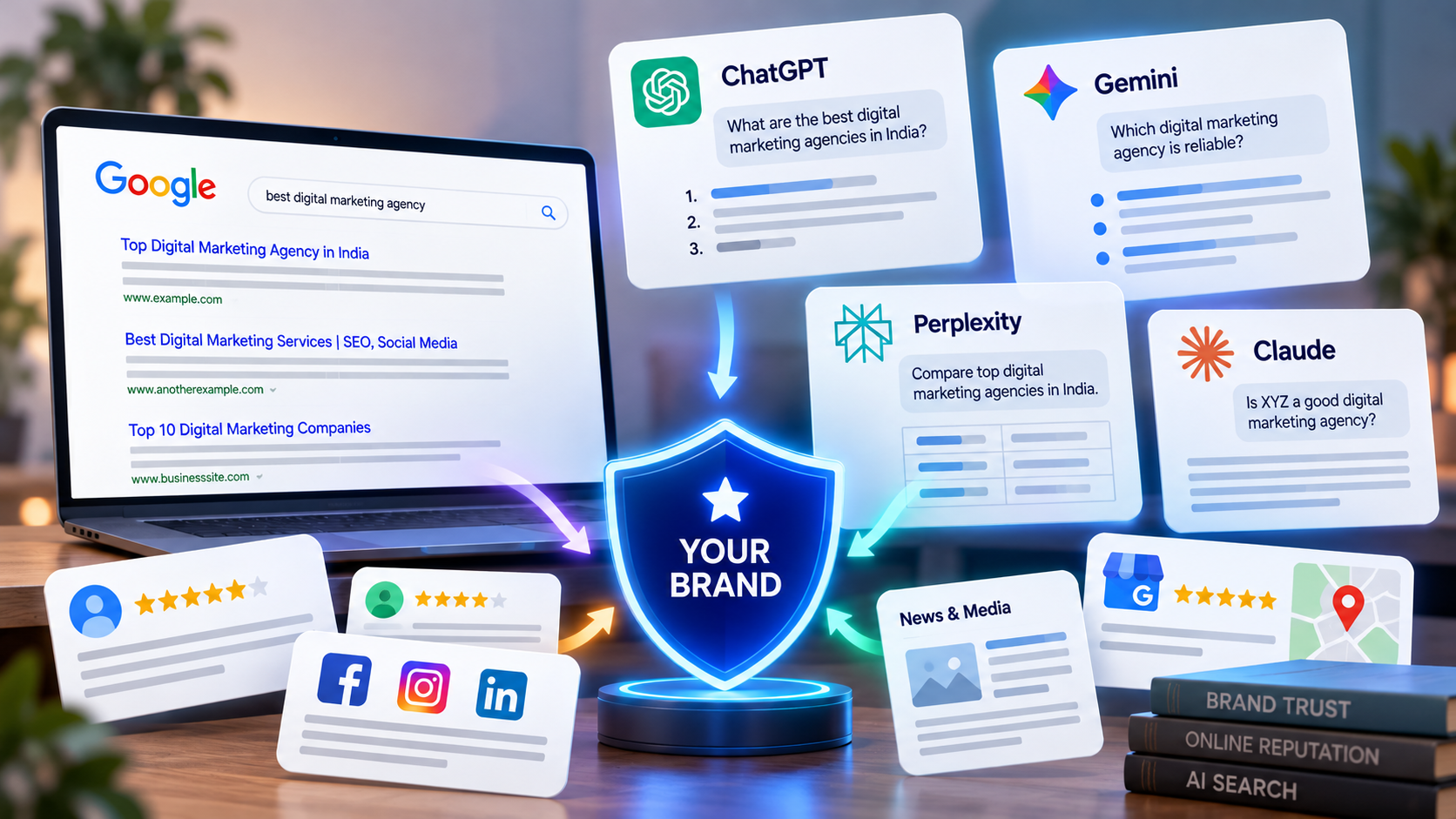
People no longer rely only on Google search results to decide whether a brand is trustworthy. They also ask AI tools questions like “Is this company reliable?”, “Which brand should I choose?” and “What do customers say about this business?”
The answers they receive can shape their opinion before they even visit a website. This is where AI reputation management comes in. It focuses on how AI-powered search tools understand, describe, and present a brand when someone asks about it.
Traditional online reputation management (ORM) still matters. Reviews, news articles, customer feedback, and search rankings continue to influence trust. Yet AI-generated answers add another layer to the process.
For businesses, the question is no longer just whether they appear on Google's first page. It is also whether AI tools present accurate, useful, and balanced information about them.
What Is AI Reputation Management?
AI reputation management is the process of monitoring and improving how a brand or individual is represented in AI-generated answers across platforms such as ChatGPT, Google AI Overviews, Gemini, and Perplexity.
Instead of focusing only on search rankings, this approach looks at the information AI tools use to describe a business.
Imagine someone asks an AI assistant to recommend a wedding planner in India. The assistant might mention three businesses, explain their services, and refer to information about their experience and customer reviews.
If your business is missing from that answer, or the information is outdated, potential customers may never consider you.
The process involves several activities:
- →Monitoring how AI tools describe your brand.
- →Checking whether business information is accurate and consistent.
- →Reviewing customer feedback and third-party brand mentions.
- →Publishing reliable information that answers common customer questions.
- →Identifying incorrect claims and outdated details.
- →Tracking changes in brand mentions and recommendations across AI platforms.
The goal is not to control every AI answer. It is to give search systems and AI tools reliable information about your brand while making it easier for people to verify what they read.
Why Google Results Are No Longer the Only Reputation Layer
Google remains a major starting point for discovering businesses. Still, the way people search is changing.
A user might once have searched for “best skincare brand in India,” opened several websites, compared reviews, and made a decision.
Now, that same person might ask an AI assistant to compare skincare brands and explain their differences.
The difference is simple. Traditional search often presents a list of sources. AI tools may combine information from several sources into one answer.
Three Layers of Online Reputation
| Reputation layer | What it includes | How it affects trust |
|---|---|---|
| Search reputation | Website pages, Google results, business profiles, and news coverage | Helps people discover and research a brand |
| Review and community reputation | Customer reviews, forums, discussions, and independent comparisons | Helps people understand real customer experiences |
| AI answer reputation | AI-generated summaries, comparisons, and recommendations | Shapes how people understand a brand before visiting its website |
These layers overlap, but they are not identical. A strong Google ranking does not guarantee that an AI assistant will mention your business or describe it accurately.
That is why brands need to look beyond rankings alone.
How AI Answers Change the Traditional ORM Playbook
Traditional ORM often focuses on review management, search result monitoring, public relations, and responding to customer feedback.
Those activities still matter. The difference is that businesses must now consider how information from different sources may appear in AI-generated answers.
1. Brand mentions matter beyond your own website
Your website tells people what you offer. Yet independent sources can help users assess whether those claims are credible.
AI tools may encounter information about your business through news coverage, industry publications, review websites, public directories, and other accessible sources.
For example, a software company that publishes detailed product documentation and receives relevant coverage from respected industry publications gives potential customers more information to evaluate.
This does not guarantee an AI mention. It does give people more reliable sources to consult.
2. Reviews need more attention than star ratings alone
A 4.5-star rating can look impressive. But what are customers actually saying?
People often want to know whether a business delivers on time, handles complaints, offers good support, or provides value for money.
Therefore, ORM teams should look beyond average ratings.
- →Read recent positive and negative reviews.
- →Identify recurring complaints.
- →Respond to genuine customer concerns.
- →Correct service issues where possible.
- →Make it easy for customers to leave honest feedback.
Over time, this work can improve the actual customer experience and create clearer public information about how the business handles problems.
3. Accurate information becomes more important
Outdated prices, incorrect addresses, old product details, and inconsistent company descriptions can confuse potential customers.
Keep your website, business profiles, product pages, and important third-party listings up to date.
If your company changes its pricing or discontinues a service, update the relevant pages rather than leaving old information online.
4. Customer questions become part of reputation management
People often ask specific questions before trusting a brand.
For example:
- →Is this company legitimate?
- →Does this product offer good value?
- →How does this service compare with competitors?
- →What do customers say about the company?
- →What should I know before buying?
Your website should answer relevant questions clearly, using factual explanations and specific details.
Where appropriate, include FAQs, transparent policies, product specifications, case studies, and explanations of how your service works.
Clear answers help customers make informed decisions and may make your content more useful to search engines and AI systems.
5. Reputation monitoring needs a wider scope
Checking Google search results is no longer enough to understand every way people might encounter your brand.
Businesses should also test relevant questions across AI search platforms.
For example, a company could ask:
- →How is our brand described?
- →Which competitors appear in recommendations for our category?
- →What information does AI provide about our pricing and services?
- →Does the answer mention outdated or incorrect details?
- →Which sources appear to support the response?
Repeat these checks over time. AI answers can vary by platform, question wording, location, and available information, so one result should not be treated as a permanent verdict.
What Is GEO ORM and How Does It Relate to AI Search Reputation?
GEO ORM refers to the overlap between generative engine optimization (GEO) and online reputation management.
GEO focuses on making information useful and accessible to generative AI search systems. ORM focuses on how people perceive a brand online.
When these activities work together, businesses can improve their information quality, strengthen their public presence, and monitor how they appear in AI-generated responses.
For example, a dental clinic might publish clear information about its treatments, dentist qualifications, consultation process, and patient FAQs. It could also maintain accurate local listings and respond professionally to reviews.
The clinic cannot guarantee that an AI tool will recommend it. Still, it can give patients and search systems better information to evaluate.
GEO ORM vs Traditional ORM
| Factor | Traditional ORM | GEO ORM |
|---|---|---|
| Main focus | Online reputation and public perception | Reputation across AI-generated answers and traditional channels |
| Key sources | Search results, reviews, news, and social platforms | Reviews, websites, publications, and sources used in AI answers |
| Monitoring | Brand searches, reviews, and negative mentions | Brand mentions, answer accuracy, cited sources, and AI visibility |
| Content approach | Manage public information and customer feedback | Provide clear, factual information that answers relevant questions |
| Measurement | Sentiment, ratings, search visibility, and reputation issues | AI answer accuracy, mentions, source visibility, sentiment, and business outcomes |
The focus should remain on credibility rather than trying to manipulate AI responses.
How to Build a Practical AI Reputation Management Strategy
You do not need a large team to begin. Start with a simple process and expand it as you learn what customers and AI platforms say about your business.
Step 1. Establish your current reputation
Search your brand name on Google and review the results.
Check your website, business profiles, reviews, media mentions, and any prominent complaints.
Then ask relevant questions about your brand on AI platforms that your customers use.
Record what you find. This gives you a baseline for future comparisons.
Step 2. Create an AI reputation monitoring sheet
Track the same set of questions every month.
Your sheet can include:
| Tracking field | What to record |
|---|---|
| AI platform | ChatGPT, Gemini, Perplexity, or Google AI Overviews |
| Exact prompt | The question asked about your brand |
| Brand mention | Whether your business appears in the answer |
| Answer accuracy | Correct, partially correct, or incorrect |
| Competitors mentioned | Other brands appearing in the response |
| Sources cited | Websites or publications referenced, where available |
| Required action | Content updates, factual corrections, or further investigation |
Use the same prompts when comparing results over time. Otherwise, changes in wording may affect the answers and make comparisons less useful.
Step 3. Fix factual gaps first
If an AI response contains incorrect information, investigate where the mistake may have originated.
Update your own website and business profiles where necessary. Contact third-party publishers if they have published incorrect details.
If the source is unclear, document the issue and check again later. Not every AI response provides enough information to identify the cause.
Step 4. Publish evidence-backed content
Create pages that explain your products, services, expertise, policies, and customer experience.
Include specific details instead of vague claims. For example, describe what a service includes, who provides it, what customers can expect, and which limitations apply.
Use expert-reviewed content when the subject requires specialist knowledge. Add author information, relevant credentials, original research, and trustworthy references where appropriate.
Step 5. Measure progress beyond rankings
Track brand mentions, the accuracy of descriptions, relevant citations, review patterns, and the questions for which your brand appears.
Also monitor conventional SEO metrics, such as organic traffic, branded searches, and conversions.
AI visibility alone does not prove that a campaign is increasing trust or revenue. Compare it with customer enquiries, qualified leads, and other business outcomes.
E-E-A-T and AI Reputation Management
Google's E-E-A-T framework stands for Experience, Expertise, Authoritativeness, and Trustworthiness. It is a useful way to think about the quality and credibility of your online presence.
E-E-A-T is not a single score that businesses can optimize, and it does not guarantee AI visibility. Still, its principles support the kind of reliable information customers need.
| E-E-A-T principle | What your brand should demonstrate | Practical example |
|---|---|---|
| Experience | First-hand knowledge and real experience | Publish genuine case studies or original product testing |
| Expertise | Relevant knowledge and qualifications | Use knowledgeable authors and expert-reviewed content |
| Authoritativeness | Recognition from relevant, credible sources | Earn legitimate industry coverage and references |
| Trustworthiness | Accurate, transparent, and reliable information | Keep policies, contact details, and service claims up to date |
Experience
Show first-hand knowledge through genuine case studies, original observations, product testing, or documented customer experiences.
For example, a service provider can explain how it approached a project and what the client achieved, provided the details are accurate and the client has agreed to their use.
Expertise
Demonstrate relevant knowledge through well-researched articles, qualified authors, accurate explanations, and specialist input where needed.
Avoid making claims that your evidence cannot support.
Authoritativeness
Build recognition through relevant industry coverage, credible references, genuine partnerships, and useful contributions to your field.
Focus on earning recognition rather than collecting low-quality links or publishing content solely to mention your brand.
Trustworthiness
Keep contact details, policies, prices, qualifications, and product information accurate.
Address complaints fairly. Correct mistakes when you find them. Be transparent about what your business can and cannot deliver.
These practices help people assess your credibility, whether they discover you through Google, an AI assistant, a review platform, or a recommendation from someone they trust.
What Does ORM Look Like When AI Answers the Question First?
The future of ORM will likely involve a combination of search monitoring, customer feedback analysis, source verification, and AI answer tracking.
A customer may encounter an AI-generated summary before visiting your website. That makes the accuracy of your public information more relevant to the buying journey.
Businesses should prepare for three practical changes.
First, reputation monitoring will extend across more discovery channels. Teams will need to understand not only where their brand ranks but also how it is described in relevant AI answers.
Second, content quality will matter alongside public credibility. A well-written website helps, but unsupported claims and unresolved customer complaints can still weaken trust.
Third, measurement will become more detailed. Businesses will need to compare AI visibility with traditional search performance, customer sentiment, leads, and conversions rather than relying on a single metric.
The aim is not to force AI systems to say positive things about a brand. It is to build a public record that accurately reflects the business and helps customers make informed decisions.
Frequently Asked Questions
What is AI reputation management?
AI reputation management is the process of monitoring and improving how brands or individuals are represented in AI-generated answers. It includes checking factual accuracy, reviewing public information, monitoring brand mentions, and addressing reputation issues.
How does AI search reputation differ from traditional ORM?
Traditional ORM often focuses on reviews, search results, media coverage, and public perception. AI search reputation also examines how AI tools summarize that information and present a brand when answering user questions.
Can a business control what ChatGPT or Google AI Overviews says about it?
No. Businesses cannot guarantee a particular AI response. They can improve the accuracy and availability of their public information, correct errors at their sources, and monitor how their brand is represented.
Does GEO ORM replace SEO?
No. GEO ORM complements SEO and traditional ORM. Website quality, crawlability, useful content, accurate business details, and credible public information remain relevant to online discovery.
How can a business measure AI reputation?
Track brand mentions, answer accuracy, competitor comparisons, cited sources, and changes in customer sentiment. Repeat a consistent set of prompts and compare the findings with website traffic, enquiries, and conversions.
When should a business start monitoring its AI reputation?
A business can start as soon as customers use AI tools to research its products or services. Begin with a baseline review, identify important factual gaps, and repeat the checks regularly.
Take the Next Step With an AI Reputation Audit
Your online reputation is no longer limited to what appears on the first page of Google. Customers may also encounter your brand through AI-generated answers, comparisons, and recommendations.
The best starting point is to understand what these platforms currently say about your business.
An AI reputation audit can help identify inaccurate brand descriptions, missing information, competitor visibility gaps, weak third-party coverage, and opportunities to improve the quality of your online presence.
Start by checking how your brand appears across traditional search and relevant AI platforms. Then use those findings to build a practical plan around accuracy, credibility, and customer trust.
Related Insights

Are AI Ad Platforms Making Marketers Better at Performance - or Just Better at Spending?
Are AI ad platforms making marketers better or just spending faster? Explore AI performance marketing, automated bidding, AI optimisation, and smarter paid media.

Social Listening Is Becoming AI Consumer Intelligence - Here’s What Changes!
Discover how AI social listening turns millions of conversations into consumer intelligence, themes, needs and early signals for smarter marketing and product decisions.

SEO Is No Longer the Whole Search Journey: Where Do Indians Ask AI Instead?
AI search in India is now becoming part of how people discover information, compare choices and decide what to do next across search engines, AI assistants, maps and marketplaces.
Ready To Make Your Stack Work Together?
Bring us the complexity. We'll help turn disconnected platforms, data and workflows into a MarTech system built around your business.