Can AI Actually Understand What People Mean Online? The Problem With Sentiment Scores!
BrandThink
Growth Field Notes
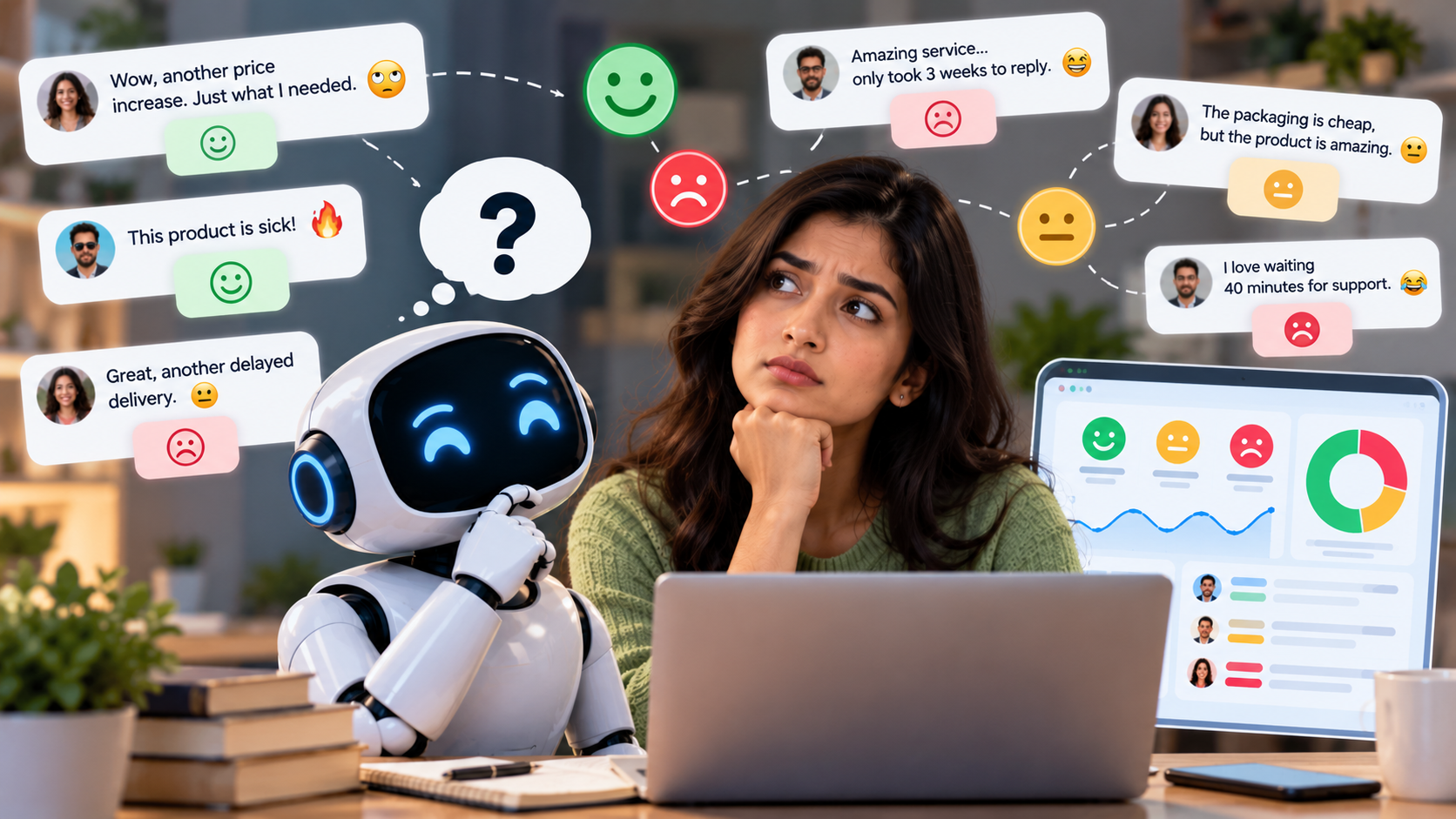
AI sentiment analysis can tell you whether an online comment sounds positive, negative, or neutral. But can it actually understand what a person means?
Think about this comment on a brand's Instagram post.
"Wow, another price increase. Just what I needed."
A basic AI tool might read this as positive because of the phrase "just what I needed." But you and I know the person is probably frustrated.
Now imagine someone writes, "This product is sick!"
Is that a complaint? Not necessarily. It could be the highest compliment a customer can give.
This is where AI sentiment analysis gets complicated. Online conversations are full of sarcasm, slang, cultural references, and mixed emotions. A simple positive or negative score often misses the real meaning behind a message.
For brands, this is more than a technical issue. It can affect customer experience, brand reputation, and business decisions.
So, can AI actually understand what people mean online? Let's look at why sentiment scores often fall short and what businesses should measure instead.
What Is AI Sentiment Analysis?
AI sentiment analysis is a method of using artificial intelligence and natural language processing (NLP) to identify the emotional tone of text.
It helps businesses understand how people feel about a brand, product, service, or topic.
For example, an AI sentiment analysis tool might classify these comments:
| Customer Comment | Basic Sentiment |
|---|---|
| "I love this product!" | Positive |
| "The delivery was terrible." | Negative |
| "The package arrived yesterday." | Neutral |
| "Great, another delayed delivery." | Negative |
The technology can process thousands of comments, reviews, social media posts, and customer messages much faster than a person could.
This makes it useful for social listening, customer feedback analysis, and brand reputation tracking.
But there is a catch.
Sentiment classification identifies patterns in language. It does not automatically mean the system understands the speaker's intention, experience, or emotional state.
And that difference matters.
7 Reasons Basic Sentiment Scores Fail to Understand Online Conversations
1. Sarcasm Can Reverse the Meaning of a Sentence
Sarcasm is one of the biggest challenges in sentiment analysis.
People often say the opposite of what they mean.
Consider this comment:
"Fantastic customer service. They only took three weeks to reply."
A basic model might identify "fantastic customer service" as positive.
But the complete sentence expresses frustration.
Why does this happen?
The sentiment depends on the relationship between the words, the situation, and the speaker's intention.
Sarcasm detection requires a system to look beyond individual words.
It may need to consider:
- →The full sentence
- →Previous messages in the conversation
- →The situation being discussed
- →Common sarcastic expressions
- →The contrast between the words and the outcome
Even advanced language models can struggle with sarcasm when the context is missing.
For brands, this means a positive sentiment score does not always indicate a satisfied customer.
2. Context Changes the Meaning of Words
A word can have different meanings depending on how someone uses it.
Take the word "cheap."
"This product is cheap."
That could mean the product is affordable.
Or it could mean the product feels poorly made.
Now consider:
"The packaging is cheap, but the product itself is excellent."
A single positive or negative label cannot fully explain this review.
This is why contextual sentiment analysis matters.
Instead of looking at the entire sentence as one emotional category, businesses need to understand what the customer feels about specific aspects of a product or service.
For example:
- →Packaging: Negative
- →Product quality: Positive
- →Overall experience: Mixed
This gives a much clearer picture of what customers actually think.
3. People Can Feel More Than One Emotion at a Time
Human emotions are rarely limited to positive or negative.
A customer might love a product but feel disappointed with the delivery.
Someone might be excited about a new feature while worrying about its price.
Consider this review:
"I love the new design, but the subscription cost is getting ridiculous."
A basic sentiment tool might classify the entire review as negative.
But that misses an important detail.
The customer likes the product. The problem is the pricing.
This is where emotion analysis becomes useful.
Rather than assigning a single sentiment score, a more detailed system can identify emotions such as:
- →Happiness
- →Frustration
- →Disappointment
- →Excitement
- →Confusion
- →Trust
- →Anxiety
It can also identify mixed emotions within the same message.
For brands, this helps separate product satisfaction from pricing concerns, service complaints, and other issues.
4. Slang and Internet Language Keep Changing
Online conversations rarely follow textbook grammar.
People use abbreviations, memes, emojis, slang, and expressions that change meaning over time.
For example:
"That update is fire."
A basic model might interpret "fire" as something dangerous or negative.
But in this context, it means the update is excellent.
Now consider:
"Bro, this feature is dead."
Does that mean the feature is no longer available? Or does the person mean it is boring?
The answer depends on the conversation.
Internet language also changes across communities.
A phrase that sounds positive in one online group might mean something completely different in another.
This creates a challenge for businesses that monitor conversations across multiple platforms, regions, and age groups.
AI systems need regular evaluation against real conversations. A model trained on older language patterns may not interpret newer slang correctly.
5. Cultural Differences Affect Sentiment
The same expression can carry different meanings across cultures.
People also express frustration, happiness, politeness, and disagreement in different ways.
For example, a customer might say:
"The service was okay."
In one context, this could be a neutral statement.
In another, it might be a polite way of expressing disappointment.
This becomes more complicated when brands operate across different countries and languages.
A sentiment model trained primarily on English-language data may struggle with:
- →Regional slang
- →Local expressions
- →Cultural references
- →Code-switching between languages
- →Different ways of expressing disagreement
Consider an Indian customer writing:
"Service toh achhi thi, but delivery kaafi late hui."
The customer is saying that the service was good, but the delivery was quite late.
A basic English-only model may struggle to interpret the mixed Hindi-English sentence correctly.
This is why multilingual sentiment analysis needs more than direct word translation.
It needs to account for how people actually communicate.
6. A Sentiment Score Does Not Explain Why People Feel That Way
Imagine your brand receives 10,000 online mentions in a month.
Your sentiment dashboard reports:
- →65% positive
- →20% neutral
- →15% negative
At first glance, this seems useful.
But what does it tell you about your business?
Not much.
You still do not know whether customers are unhappy with your pricing, delivery, product quality, customer support, or website experience.
The negative sentiment could come from a single issue affecting thousands of customers.
Or it could be spread across several unrelated problems.
This is why businesses need to connect sentiment with topics, products, and customer experiences.
For example:
| Topic | Sentiment | Possible Business Action |
|---|---|---|
| Product quality | Positive | Maintain current standards |
| Delivery delays | Negative | Review shipping operations |
| Pricing | Mixed | Evaluate perceived value |
| Customer support | Negative | Improve response times |
This type of analysis gives businesses a better starting point for action.
7. AI Can Misread the Difference Between a Complaint and a Joke
Online conversations are often playful.
People joke about brands, products, and everyday experiences.
For example:
"My laptop has decided to retire before I do."
A basic sentiment tool might identify "retire" as a negative signal.
But the person may simply be making a joke about an old laptop.
Now imagine a customer writing:
"Love waiting 40 minutes for support."
The sentence is humorous, but it also expresses a genuine complaint.
The challenge is not just identifying whether the sentence is positive or negative.
It is understanding whether the person is joking, complaining, expressing frustration, or doing several things at once.
This is why sentiment scores should be treated as signals rather than complete explanations.
What Comes After Basic Sentiment Analysis?
The next step is not simply assigning more accurate positive and negative labels.
Businesses need a deeper understanding of online conversations.
Here are four areas worth exploring.
1. Contextual Sentiment Analysis
Contextual sentiment analysis looks at the meaning of a message within its surrounding conversation.
It considers how words relate to one another and how the situation changes their meaning.
For example:
"The product is great, but the support team is useless."
A contextual model can identify positive sentiment toward the product and negative sentiment toward customer support.
This is more useful than assigning one overall score.
2. Aspect-Based Sentiment Analysis
Aspect-based sentiment analysis (ABSA) identifies sentiment toward specific features, services, or topics.
For example:
"The phone has an amazing camera, but the battery life is disappointing."
The model can identify:
- →Camera: Positive
- →Battery life: Negative
This helps businesses understand which parts of their products customers appreciate and which areas need attention.
It is especially useful for ecommerce reviews, product feedback, and customer experience analysis.
3. Emotion Analysis
Emotion analysis goes beyond positive and negative sentiment.
It attempts to identify the specific emotions expressed in a message.
For example:
"I have been waiting for my refund for two weeks. This is ridiculous."
The message may express frustration, anger, and disappointment.
These emotions can help businesses prioritize customer issues.
A frustrated customer waiting for a refund may need a different response from someone asking a simple product question.
4. Sarcasm Detection and Intent Analysis
Sarcasm detection helps identify when the literal meaning of a sentence differs from the intended meaning.
Intent analysis goes one step further by identifying what the person is trying to communicate.
For example:
"Great, another broken feature."
The system may identify:
- →Sentiment: Negative
- →Emotion: Frustration
- →Intent: Complaint
- →Topic: Product functionality
This gives a more complete view of the conversation.
Still, no model will interpret every message correctly. Human review remains useful for ambiguous or high-impact cases.
How Businesses Can Use AI Sentiment Analysis More Effectively
If you are using AI to monitor brand reputation, start by asking what decisions the data should support.
A few practical steps can help.
Step 1. Track Topics Alongside Sentiment
Do not stop at positive and negative percentages.
Identify the subjects people are discussing.
This helps you understand what is driving sentiment.
Step 2. Monitor Changes Over Time
A sudden increase in negative mentions about a product or service may signal a developing problem.
Compare sentiment trends with customer support tickets, product updates, and business events.
Step 3. Review Real Customer Conversations
AI can process large amounts of data, but human reviewers can help identify patterns that automated models miss.
Review samples of positive, negative, mixed, and neutral messages.
Pay particular attention to sarcasm, slang, and multilingual conversations.
Step 4. Measure Accuracy Against Human Judgement
Create a sample of customer messages and have human reviewers label them.
Then compare the model's predictions with those labels.
Measure performance using metrics such as:
- →Precision
- →Recall
- →F1 score
- →Confusion matrix
This helps you understand where the model performs well and where it struggles.
Step 5. Connect Sentiment With Business Outcomes
Sentiment data becomes more useful when you connect it with customer experience and business performance.
For example, you might compare negative sentiment about delivery with refund requests, repeat purchases, and customer support volume.
This helps you understand whether a sentiment trend reflects a real business issue.
Can AI Actually Understand What People Mean Online?
AI can identify patterns, interpret context, and estimate the meaning of many online conversations.
Modern language models can also recognize sarcasm, mixed emotions, and cultural expressions better than simple word-based sentiment tools.
But there is still a difference between identifying the likely meaning of a message and fully understanding the person behind it.
A sentiment score is an estimate.
It is not a complete explanation of human emotion.
For businesses, the goal should be to move beyond basic positive and negative labels.
Contextual sentiment, emotion analysis, aspect-based sentiment analysis, and intent detection can provide a more useful view of customer conversations.
The real value comes when you connect these insights with actual business decisions.
Because knowing that a customer is unhappy is one thing.
Understanding why they are unhappy, what they need, and how your brand should respond is a much more useful starting point.
Frequently Asked Questions
1. Can AI sentiment analysis understand sarcasm?
AI sentiment analysis can identify some forms of sarcasm by analyzing context, language patterns, and relationships between words. Still, sarcasm detection remains difficult because the intended meaning may differ from the literal meaning.
2. Why are sentiment scores sometimes inaccurate?
Sentiment scores can be inaccurate because of sarcasm, slang, cultural differences, mixed emotions, missing context, and ambiguous language.
3. What is contextual sentiment analysis?
Contextual sentiment analysis evaluates the meaning of a message within its surrounding conversation. It helps identify sentiment that depends on context rather than individual words.
4. What is the difference between sentiment analysis and emotion analysis?
Sentiment analysis typically identifies whether a message expresses positive, negative, or neutral feelings. Emotion analysis attempts to identify more specific emotions, such as anger, happiness, frustration, or disappointment.
5. What is aspect-based sentiment analysis?
Aspect-based sentiment analysis identifies sentiment toward specific features, products, or services. For example, a review may express positive sentiment about product quality and negative sentiment about delivery.
6. How can businesses improve sentiment analysis accuracy?
Businesses can improve accuracy by using contextual models, reviewing real conversations, evaluating performance against human-labelled data, and accounting for language and cultural differences.
7. What comes after basic sentiment analysis?
The next stage includes contextual sentiment analysis, emotion detection, aspect-based sentiment analysis, sarcasm detection, and intent analysis. These approaches provide a more detailed understanding of customer conversations.
Need a Clearer Picture of Your Brand Reputation?
If your brand is receiving thousands of online mentions but your sentiment dashboard is not explaining what customers actually mean, it may be time to review your approach.
A reputation intelligence audit can help you assess your current sentiment tracking, identify gaps in contextual analysis, and understand how AI is interpreting customer conversations.
The goal is simple.
Move beyond sentiment scores and get a clearer understanding of what people are saying about your brand, why they are saying it, and what you can do about it.
Related Insights

Are AI Ad Platforms Making Marketers Better at Performance - or Just Better at Spending?
Are AI ad platforms making marketers better or just spending faster? Explore AI performance marketing, automated bidding, AI optimisation, and smarter paid media.

Social Listening Is Becoming AI Consumer Intelligence - Here’s What Changes!
Discover how AI social listening turns millions of conversations into consumer intelligence, themes, needs and early signals for smarter marketing and product decisions.

SEO Is No Longer the Whole Search Journey: Where Do Indians Ask AI Instead?
AI search in India is now becoming part of how people discover information, compare choices and decide what to do next across search engines, AI assistants, maps and marketplaces.
Ready To Make Your Stack Work Together?
Bring us the complexity. We'll help turn disconnected platforms, data and workflows into a MarTech system built around your business.