Are AI Ad Platforms Making Marketers Better at Performance - or Just Better at Spending?
BrandThink
Growth Field Notes
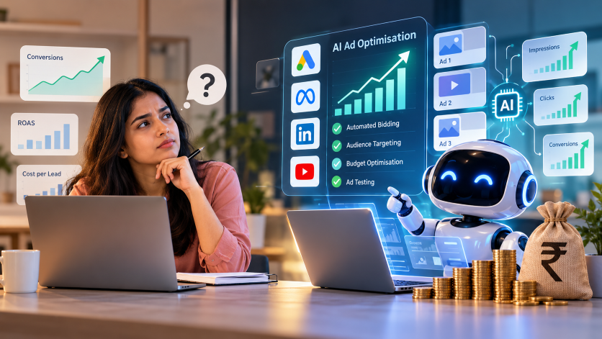
AI performance marketing is changing how marketers plan, run, and measure paid campaigns. With AI ad optimisation, automated bidding, and paid media AI now built into major advertising platforms, campaigns can adjust faster than a human team ever could.
But there is a catch.
If a platform can spend your budget faster, find audiences automatically, adjust bids in real time, and generate dozens of ad variations, does that actually make you a better marketer? Or does it simply make you better at spending money?
That question matters because automation can improve campaign performance without necessarily improving marketing strategy.
What Is AI Performance Marketing?
AI performance marketing uses machine learning and automated systems to help marketers improve paid campaigns.
These systems can analyse large amounts of campaign data and make decisions around:
- →Audience targeting
- →Ad placement
- →Bid amounts
- →Budget distribution
- →Creative combinations
- →Conversion signals
- →Campaign performance
- →Customer behaviour
For example, instead of manually deciding which audience should receive a higher bid, an advertising platform can evaluate thousands of signals and adjust bids automatically.
That sounds useful. And it is.
But there is a difference between automating decisions and making better decisions.
A platform may know which users are more likely to click. Your marketing team still needs to know whether those users are actually valuable customers.
1. AI Ad Optimisation Can Make Campaigns Faster
One of the biggest advantages of AI ad optimisation is speed.
Previously, marketers might review campaign data once or twice a day. They would then change bids, pause ads, move budgets, or adjust targeting.
AI systems can make these adjustments continuously.
For example, imagine you are running three campaigns:
- →Campaign A generates leads at ₹700 each
- →Campaign B generates leads at ₹450 each
- →Campaign C generates leads at ₹900 each
An automated system can quickly shift more budget toward Campaign B.
That can save time. It can also reduce the amount of repetitive work your team needs to handle.
But there is another question. Are those ₹450 leads actually better? If Campaign A produces customers worth ₹20,000 while Campaign B produces customers worth ₹2,000, the cheaper lead is not necessarily the better result. This is where human judgement still matters.
2. Automated Bidding Does Not Mean Better Strategy
Automated bidding has become a standard part of paid advertising. The system uses signals such as:
- →Device
- →Location
- →Search behaviour
- →Time
- →Previous interactions
- →Conversion history
- →Audience characteristics
It then adjusts bids based on the probability of achieving the campaign goal. That can be extremely useful. Still, automated bidding works within the rules you give it.
If you optimise for cheap leads, the system will look for cheap leads. If you optimise for conversions, it will try to generate conversions. If you optimise for revenue, it needs reliable revenue data to make useful decisions.
So before turning on automated bidding, ask yourself: What exactly am I asking the platform to optimise? A poorly chosen goal can simply make bad marketing happen faster.
3. Paid Media AI Can Find Patterns Humans Miss
AI has one major advantage over humans: Scale. A person cannot realistically compare millions of signals across thousands of ad impressions. Machine learning systems can. This makes paid media AI useful for identifying patterns that may not be obvious to a marketer.
For example, an AI system might discover that users who:
- →Visit a specific product page
- →Return within seven days
- →Use mobile devices
- →Come from a particular location
- →Interact with a certain type of ad
are more likely to convert. A marketer might not spot that pattern manually. Still, the marketer needs to ask why that pattern exists. Data can tell you what happened. It does not always tell you what you should do next.
4. More Automation Can Create More Wasted Spend
This is where the conversation gets uncomfortable. AI can spend money very efficiently. But efficient spending is not the same thing as profitable spending.
Suppose an advertising platform increases your conversion rate from 3% to 5%. That looks great. But what if the average order value falls by 40% at the same time? Your dashboard may show better conversion performance while your business makes less money.
This is why marketers should look beyond surface-level metrics. Track:
- →Customer acquisition cost
- →Revenue per customer
- →Profit margin
- →Customer lifetime value
- →Qualified leads
- →Repeat purchases
- →Conversion quality
A campaign should not receive more budget simply because the platform says it is performing well. Look at what happens after the conversion.
5. AI Can Make Average Creative Better, But Not Always Great
AI can help marketers create more headlines, descriptions, images, and variations. This gives teams more options to test. For example, instead of producing five headlines manually, AI can help generate 30 variations. That sounds like a clear advantage.
But quantity does not automatically create better advertising. Good advertising still needs:
- →A clear customer problem
- →A strong reason to act
- →A useful offer
- →A clear message
- →Brand understanding
- →Knowledge of the audience
If every competitor uses similar AI-generated messaging, ads can start sounding strangely familiar. Have you noticed how many ads now seem to use the same phrases? That is one reason human input still matters. AI can produce variations. You still need to decide which ideas are worth testing.
6. The Best Marketers Are Learning How to Work With AI
The role of the performance marketer is changing. You may spend less time adjusting individual bids and more time thinking about:
- →Campaign structure
- →Customer economics
- →Measurement
- →Creative testing
- →First-party data
- →Audience quality
- →Attribution
- →Business goals
This does not make marketers less important. It changes where their attention goes. A strong marketer should understand how the AI system works well enough to question its output.
For example:
- →Why did the platform move 35% of the budget to this campaign?
- →Why did the cost per lead fall?
- →Why did conversion volume increase but revenue stay flat?
- →Why is one audience receiving most of the spend?
Those questions are more valuable than simply watching a dashboard.
7. AI Performance Marketing Needs Better Data
AI is only as useful as the signals it receives. If your conversion tracking is inaccurate, your AI system learns from inaccurate information. If you count every form submission as a successful lead, the platform may optimise for people who submit forms but never become customers. That creates a serious problem.
Your tracking should connect advertising activity with actual business outcomes whenever possible. For example:
Ad click → Landing page → Lead → Qualified lead → Sales call → Customer → Revenue
The further your data goes down this chain, the more useful your optimisation signals become. This is one area where marketers can gain a real advantage. Don't just feed platforms more data. Feed them better data.
How Should Marketers Use AI Without Losing Control?
You don't need to choose between manual marketing and full automation. A better approach is to divide the work. Let AI handle tasks where speed and scale matter. Keep humans involved where judgement matters.
Let AI handle:
- →Bid adjustments
- →Large-scale data analysis
- →Audience pattern detection
- →Budget recommendations
- →Ad variation testing
- →Reporting
- →Routine campaign changes
Let marketers handle:
- →Positioning
- →Customer research
- →Offer strategy
- →Brand messaging
- →Budget decisions
- →Business goals
- →Creative direction
- →Performance interpretation
This balance gives you automation without handing over the entire marketing strategy.
AI Ad Optimisation Should Be Judged by Business Results
The real question is not whether AI can improve your advertising dashboard. It clearly can. The better question is whether it improves your business.
Before increasing an AI-managed campaign budget, check:
- →1. Are conversions increasing?
- →2. Are qualified conversions increasing?
- →3. Is customer acquisition cost sustainable?
- →4. Is revenue growing?
- →5. Are margins healthy?
- →6. Are customers coming back?
- →7. Can you explain why performance changed?
If the answer to most of these questions is yes, the automation is doing something useful. If only clicks and conversions are improving, take a closer look.
A Simple Framework for Using Paid Media AI
You can use this five-step approach when introducing AI into your campaigns:
- →1. Set the business goal: Don't start with "get more conversions." Start with the actual business outcome you want. For example, "generate 100 qualified leads at a cost below ₹1,000 each."
- →2. Fix your tracking: Make sure the platform receives reliable conversion and revenue data.
- →3. Start with controlled automation: Don't automate everything on day one. Test automated bidding, audience expansion, or creative testing in controlled campaigns.
- →4. Compare quality, not just volume: Look beyond CPA and conversion rate. Check lead quality, revenue, and customer value.
- →5. Review the AI's decisions: Ask why the platform is spending where it is spending. You don't need to manually control every decision. You do need to understand the important ones.
Frequently Asked Questions About AI Ad Platforms
1. What is AI performance marketing?
AI performance marketing uses artificial intelligence and machine learning to help manage and improve digital advertising campaigns. It can analyse campaign data, adjust bids, identify audiences, test ads, and distribute budgets based on performance signals.
2. How does AI ad optimisation improve paid advertising?
AI ad optimisation can analyse large amounts of campaign data much faster than a person can. It can adjust bids, identify patterns, test different ad combinations, and move budget toward campaigns that are more likely to achieve the selected goal.
3. What is automated bidding in digital advertising?
Automated bidding allows an advertising platform to set and adjust bids automatically. The system uses signals such as user behaviour, device, location, time, and previous conversion data to decide how much to bid for an advertising opportunity.
4. Can AI reduce wasted advertising spend?
Yes, but it depends on the data and goals provided to the platform. AI can reduce inefficient spending by shifting budgets and bids based on performance. Still, poor conversion tracking or the wrong campaign goal can cause AI to spend more money on the wrong outcomes.
5. What is paid media AI?
Paid media AI refers to artificial intelligence tools used to manage and improve paid advertising across platforms such as search, social media, display, and other digital channels. These tools can help with bidding, targeting, creative testing, budget decisions, and performance analysis.
6. Will AI replace performance marketers?
AI is unlikely to remove the need for performance marketers entirely. Instead, it can reduce repetitive campaign management work. Marketers still need to handle strategy, customer research, positioning, creative direction, measurement, and business decisions.
7. What should marketers measure when using AI advertising?
Marketers should look beyond clicks and conversion rates. Useful metrics include customer acquisition cost, qualified leads, revenue, profit margin, customer lifetime value, repeat purchases, and conversion quality.
8. Is AI advertising better than manual campaign management?
Neither approach is automatically better. AI works well for tasks that involve large amounts of data and frequent adjustments. Human marketers remain important for strategic decisions, creative direction, customer understanding, and judging whether campaign results actually support business goals.
9. How can businesses use AI ad platforms effectively?
Start with clear business goals and accurate tracking. Then test automation gradually. Give the platform reliable conversion data, monitor the quality of results, and review where the budget is going. The goal should be better business results, not simply more automated activity.
So, Are AI Ad Platforms Making Marketers Better?
The answer is both yes and no. AI performance marketing can make marketers faster. It can help them process more data, test more ideas, identify patterns, and manage campaigns at a scale that would be difficult manually.
But AI cannot decide what good marketing means for your business. That part still belongs to you.
The strongest marketers won't compete with AI by trying to do everything manually. They will use AI for repetitive decisions while spending more time on strategy, customers, creative thinking, measurement, and business outcomes.
So before you give an AI system another budget increase, ask one simple question: Is it helping me become a better marketer, or is it simply helping me spend faster? That answer can make a big difference to your next campaign.
Article Summary
AI is changing how marketers run paid advertising. From automated bidding and AI ad optimisation to audience targeting and creative testing, ad platforms can now make thousands of decisions with little manual input. But more automation does not always mean better marketing. This article explores how AI performance marketing can improve campaign speed and efficiency, where it can waste budget, and why marketers still need human judgement to connect advertising performance with real business results.
Related Insights
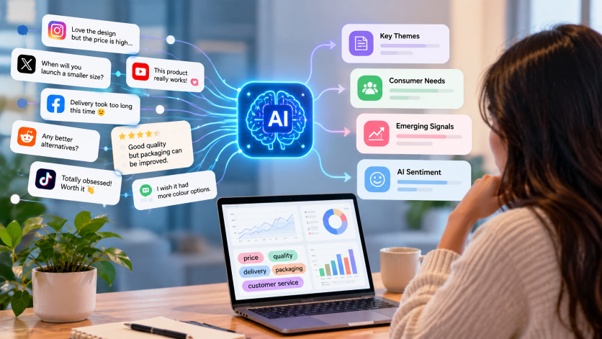
Social Listening Is Becoming AI Consumer Intelligence - Here’s What Changes!
Discover how AI social listening turns millions of conversations into consumer intelligence, themes, needs and early signals for smarter marketing and product decisions.

SEO Is No Longer the Whole Search Journey: Where Do Indians Ask AI Instead?
AI search in India is now becoming part of how people discover information, compare choices and decide what to do next across search engines, AI assistants, maps and marketplaces.

The Marketing Agent Is Here: What Should Brands Actually Let AI Do?
AI agents for marketing are moving from experiments to everyday work. What should we actually allow an AI agent to do without asking a human every five minutes?
Ready To Make Your Stack Work Together?
Bring us the complexity. We'll help turn disconnected platforms, data and workflows into a MarTech system built around your business.