The Ad Creative Arms Race What Happens When Every Brand Can Generate 1,000 Creatives?
BrandThink
Growth Field Notes

AI ad creative testing is changing how brands develop, test, and improve their advertising. A team that once spent days creating a handful of ad variations can now generate hundreds of headlines, visuals, product angles, and video concepts in a much shorter time.
That sounds like a clear advantage, right?
Not necessarily.
When every competitor can produce more ads at a lower cost, creative volume stops being a reliable advantage on its own. The real challenge becomes finding ideas that attract attention, communicate a clear benefit, and give customers a reason to remember one brand over another.
Think about your own social media feed. You might scroll past dozens of advertisements in a few minutes. Many use similar product shots, familiar hooks, and almost identical promises. Even when the ads look different, the underlying message often feels the same.
That is the problem brands need to solve.
Generative AI makes creative production easier. But producing more advertisements does not automatically mean better advertising.
The brands that stand out will need to combine useful ideas, disciplined testing, customer understanding, and a recognisable identity.
What Is the AI Ad Creative Arms Race?
The AI ad creative arms race describes the growing competition between brands to produce, test, and refresh advertising at scale using generative AI and automation tools.
Instead of creating each advertisement manually, marketers can use AI to generate multiple versions of an existing concept.
For example, an online skincare brand could develop:
- →Five headlines focused on a specific skin concern.
- →Four visual concepts showing different product uses.
- →Three versions of its main product benefit.
- →Two calls to action for different customer needs.
Combining these elements could create 120 possible variations before the team develops additional concepts.
AI tools can also help create video scripts, product backgrounds, image variations, and audience-specific messages.
However, these variations are not necessarily 120 distinct creative ideas. Many may share the same underlying concept.
That difference matters because changing a headline or background does not always change why a customer should care.
The real objective is not to produce the largest number of advertisements. It is to discover which ideas work, understand why they work, and use those findings to improve future campaigns.
1. Why Generative AI Ads Are Changing Creative Testing
Traditional creative testing often involved a relatively small number of advertisements because producing each variation required time, design work, copywriting, and approvals.
Generative AI ads reduce some of that effort.
A marketer can develop several creative directions, generate variations, and prepare assets for different placements without starting from scratch every time.
This creates three useful opportunities.
Faster creative production
Teams can explore more headline angles, product benefits, and visual approaches before launching a campaign.
For example, a furniture brand could test whether customers respond more strongly to space-saving designs, affordable pricing, or easy assembly.
More relevant creative variations
Different customers may respond to different benefits. AI can help adapt messages to specific audience needs while keeping the core product information consistent.
Faster learning cycles
When marketers organise tests properly, they can identify which creative elements deserve further investigation.
Still, AI output needs human review. A generated image might misrepresent a product, a headline could make an unsupported claim, or a variation might communicate the wrong message.
The advantage comes from using AI to explore possibilities while people decide which possibilities are worth testing.
2. Why More Ad Variations Do Not Always Produce Better Results
Creative automation makes production cheaper, but it does not remove the need for good ideas.
Imagine a brand creates 1,000 advertisements using the same basic concept. The team changes colours, rearranges product images, rewrites headlines, and swaps calls to action.
Technically, it has a large creative library.
Strategically, it may have only one idea.
This creates several problems.
- →Creative sameness: Ads look different but communicate the same message as competitors.
- →Weak testing: Teams launch too many variations without a clear hypothesis.
- →Limited learning: Results become difficult to interpret when multiple elements change at once.
- →Audience overload: Similar messages repeatedly reach the same people.
- →Review pressure: Teams struggle to check accuracy, brand consistency, and quality across large volumes of assets.
More variations can help when they test meaningful differences. But if a team cannot explain what each test is meant to discover, production volume may simply create more work.
A better question is this: What do we expect to learn from this advertisement that we cannot learn from the existing ones?
If there is no clear answer, the variation may not deserve budget or testing time.
3. AI Ad Creative Testing Needs Better Experiments, Not Just More Assets
AI ad creative testing works best when marketers treat it as a learning process rather than a contest to produce the most variations.
Start with a clear hypothesis.
For example, a direct-to-consumer brand might believe that customers care more about product durability than low pricing.
Instead of launching dozens of unrelated ads, the team could compare two creative concepts.
- →Concept A focuses on affordability.
- →Concept B focuses on durability.
The team keeps other major variables as consistent as practical. It then evaluates the results using metrics that match the campaign objective.
For a sales campaign, these could include conversion rate, cost per acquisition, and contribution margin. For an awareness campaign, the team might examine reach, completed video views, brand recall, or other suitable indicators.
The next step is to interpret the results.
If durability-focused creative generates more clicks but fewer purchases, it may attract attention without attracting the right buyers. If it generates fewer clicks but more profitable orders, it may be the stronger commercial option.
The result depends on the business goal.
A practical testing process looks like this:
- →1. Identify a customer problem or unanswered question.
- →2. Develop two or more meaningfully different creative concepts.
- →3. Choose one primary hypothesis for the test.
- →4. Define the audience, budget, duration, and success metric.
- →5. Run the test under comparable conditions.
- →6. Review results and account for uncertainty.
- →7. Apply the learning to the next round of creative development.
Avoid declaring a winner based on a handful of conversions. Small samples can produce misleading results, especially when conversion rates fluctuate.
4. How to Reduce Ad Fatigue Without Losing Brand Identity
Ad fatigue occurs when people become less responsive to advertisements after repeated exposure. It can show up as declining engagement, falling conversion rates, or rising acquisition costs, although these changes can also result from other factors.
Generative AI offers a faster way to refresh creative assets. But replacing an image every few days will not solve every fatigue problem.
Sometimes the audience has seen the message too often. Sometimes the offer is no longer relevant. In other cases, the advertisement attracts the wrong people or the product page fails to convert them.
Before refreshing a campaign, check the underlying cause.
Practical ways to address ad fatigue
- →Monitor frequency alongside engagement and conversion trends.
- →Compare performance across audience segments and placements.
- →Refresh the creative concept when the underlying message has become repetitive.
- →Test a different product benefit, use case, or customer problem.
- →Review landing pages, pricing, and offers before blaming the advertisement.
- →Use frequency controls where the advertising platform supports them.
For example, a travel company could move from generic destination imagery to creative focused on family trips, short weekend breaks, and flexible itineraries.
These are different reasons to consider the same service. They give the audience new information instead of presenting the same advertisement in a slightly different format.
At the same time, keep recognisable brand elements consistent. Customers should still be able to identify the company across creative variations.
5. What Will Separate Winning Creative From AI-Generated Noise?
When production becomes easier, the value of original thinking increases.
AI can help generate concepts, but it does not automatically know which customer insight will make a brand stand out in a crowded market.
The strongest creative often begins with a clear understanding of the audience.
What problem are customers trying to solve? What stops them from purchasing? Which product benefit matters most? What do they misunderstand about the category?
These questions should guide creative development.
Start with customer insight
Use customer interviews, support conversations, reviews, search queries, and sales feedback to identify real concerns.
For example, a customer might hesitate to buy a desk because they are unsure whether it will fit into a small apartment. An advertisement demonstrating the desk's dimensions and storage options may be more useful than another generic lifestyle image.
Build a recognisable brand identity
Use consistent visual cues, tone, product presentation, and distinctive messaging.
The aim is not to make every advertisement identical. It is to help customers connect different campaigns with the same brand.
Test different ideas, not just different formats
A product demonstration, customer story, comparison, and problem-solving video can communicate different reasons to buy.
These differences are often more meaningful than simply changing an image's background.
Keep human judgment in the process
People should review factual accuracy, product representation, tone, and originality before an advertisement goes live.
AI can speed up production. Human judgment helps determine whether the work is relevant, believable, and worth showing to customers.
6. A Practical Framework for Creative Automation at Scale
Brands do not need to test every possible variation. They need a repeatable process that connects creative production with measurable learning.
Use this four-stage framework.
| Stage | What to do | What to measure |
|---|---|---|
| Research | Identify customer problems and buying objections | Customer insights and common questions |
| Develop | Create distinct concepts and generate suitable variations | Concept coverage and review quality |
| Test | Compare selected concepts under defined conditions | Conversion rate, CPA, or campaign-specific metrics |
| Learn | Document results and develop the next round | Repeatable insights and incremental performance |
Start with a manageable number of distinct concepts. Expand the testing pool when you have a clear reason to do so and enough budget to evaluate the results.
For example, a brand might begin with three concepts, develop four variations of each, and test the resulting 12 advertisements in a structured way.
This is often more useful than launching 1,000 unorganised assets.
Also, document the findings. If a product demonstration performs well because it answers a common customer objection, record that insight so future campaigns can build on it.
Over time, the business develops a better understanding of which messages work for which audiences and under what conditions.
7. How to Measure Creative Quality Beyond Clicks
Clicks can tell you whether an advertisement attracts attention. They cannot tell you everything about its commercial value.
A creative testing report should connect the campaign objective with meaningful outcomes.
Useful metrics include:
- →Click-through rate to understand initial response.
- →Conversion rate to understand how often visitors complete the intended action.
- →Cost per acquisition to understand the cost of gaining a customer.
- →Contribution margin to assess profitability after relevant variable costs.
- →Video completion rate for suitable video objectives.
- →Brand recall or recognition when evaluating longer-term brand effects.
- →Incremental conversions when a controlled experiment can estimate the additional impact.
For example, an advertisement with a high click-through rate might generate low-quality traffic. Another with fewer clicks might attract customers who purchase more often or generate higher margins.
The second advertisement could be more valuable even if its initial engagement looks weaker.
Measurement also needs context. Seasonality, competitor activity, audience changes, bidding conditions, and landing-page performance can influence results.
Do not credit every improvement to the creative itself without checking these factors.
8. What Brands Should Prepare for Next
The next phase of AI-driven advertising will likely involve more automated asset generation, faster creative adaptation, and closer connections between campaign data and content production.
As these tools become easier to access, the ability to generate variations may become less distinctive.
Brands should prepare by investing in three areas.
Better customer knowledge. Build a clear record of customer needs, objections, purchase motivations, and product benefits.
Stronger creative direction. Develop original concepts that connect those needs with a recognisable brand identity.
More disciplined testing. Use clear hypotheses, suitable sample sizes, meaningful metrics, and documented results.
Businesses should also establish rules for AI-generated content, including fact-checking, rights management, privacy, brand approvals, and accurate product representation.
The goal is not to automate every creative decision. It is to remove unnecessary production work so teams can spend more time understanding customers and improving ideas.
Frequently Asked Questions
What is AI ad creative testing?
AI ad creative testing is the process of using AI-generated or AI-assisted advertisements to compare creative concepts, messages, visuals, and formats. Marketers measure the results against a defined objective to identify which approaches perform better.
How do generative AI ads affect advertising performance?
Generative AI ads can reduce production time, help teams explore more concepts, and make creative refreshes easier. Their actual performance depends on the quality of the ideas, audience relevance, testing methods, and campaign conditions.
Can AI help reduce ad fatigue?
Yes. AI can help produce fresh creative variations and explore different customer benefits. Still, marketers need to identify the cause of declining performance before changing assets. Audience saturation, weak offers, and landing-page problems may also contribute.
How many ad creatives should a brand test?
There is no universal number. The right volume depends on the budget, audience size, campaign objective, conversion volume, and time available. A smaller set of distinct, well-designed tests can provide more useful learning than hundreds of poorly controlled variations.
How can brands stand out when everyone uses AI?
Brands can stand out through original customer insights, distinctive creative ideas, consistent identity, accurate information, and relevant product benefits. AI can help produce the work, but the strategy must give people a reason to pay attention.
Will AI replace creative strategists?
AI can automate parts of research, ideation, production, and analysis. Creative strategists still play a key role in understanding customer needs, selecting ideas, protecting brand identity, and interpreting results. Their work may shift towards making better decisions rather than manually producing every asset.
The Real Advantage Is Learning Faster
When every brand can generate 1,000 creatives, the number itself stops being impressive.
What matters is whether those creatives test meaningful ideas, help marketers understand customers, and improve business results.
Generative AI ads can reduce production costs and speed up creative development. But without a clear testing plan, more assets can lead to more noise, more ad fatigue, and less distinctive messaging.
The better approach is straightforward.
Understand your audience. Develop different creative concepts. Test them with a clear purpose. Measure the outcomes that matter. Then use what you learn to improve the next campaign.
That is how brands can turn creative automation into a real advantage.
Ready to Improve Your Creative Testing Process?
A creative testing audit can help you review your current advertisements, identify gaps in your testing approach, spot signs of creative fatigue, and find opportunities to improve creative differentiation.
Book a creative testing audit to build a clearer process for testing ideas, measuring results, and deciding which advertisements deserve more investment.
Related Insights

Are AI Ad Platforms Making Marketers Better at Performance - or Just Better at Spending?
Are AI ad platforms making marketers better or just spending faster? Explore AI performance marketing, automated bidding, AI optimisation, and smarter paid media.
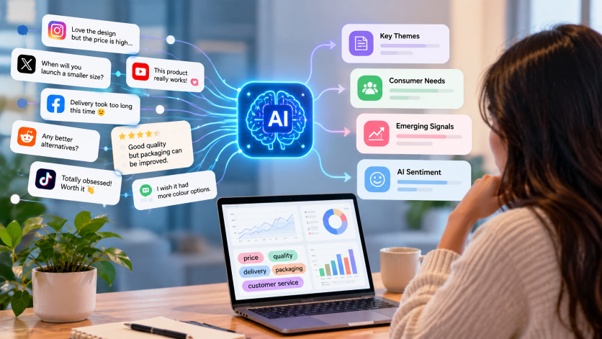
Social Listening Is Becoming AI Consumer Intelligence - Here’s What Changes!
Discover how AI social listening turns millions of conversations into consumer intelligence, themes, needs and early signals for smarter marketing and product decisions.

SEO Is No Longer the Whole Search Journey: Where Do Indians Ask AI Instead?
AI search in India is now becoming part of how people discover information, compare choices and decide what to do next across search engines, AI assistants, maps and marketplaces.
Ready To Make Your Stack Work Together?
Bring us the complexity. We'll help turn disconnected platforms, data and workflows into a MarTech system built around your business.